Organic Living

Standard

My doctor looked up from the results of recent lab tests, sighed, and reported that I am as healthy as modern chemistry can make me.  The numbers were all good.  Not long thereafter he retired–I believe it was in frustration, but I’m not entirely sure.

Witch’s Brew

It is a rather trite cocktail of statins, beta-blockers, diuretics, a thyroid pill for color, and then something to mitigate the damage to my stomach done by the foregoing concoction.  To that I have added a multi-vitamin, some red yeast rice, CoQ10, lutein, low-dose aspirin (of course) and a dash of niacin.  These are then divided into four groups:  1) before breakfast, 2) after breakfast, 3) with dinner, 4) bedtime.  I have four colored containers, each with seven compartments—one for each day of the week.  Every Saturday or Sunday I go through the ritual of bringing out the entire pharmacy and putting each pill in its proper compartment for the coming week. 

This last week, I was observing the ritual when my son Jim walked into the kitchen.  After all, it’s his kitchen.  Yes, we’re still living with Jim, Carli and little Emmett.  Our house is not yet done.  Our newest move-in date is August 6.  So, we are the house guests that came and never left—a sitcom ready for prime time.  Jim and Carli, to their everlasting credit, continue to be gracious and patient.

Anyway, Jim walked into the kitchen, saw the cornucopia of drugs and asked, “So how much longer do you think you have to live, Dad?”  I gave him the same answer that my doctor gave me not too long ago:  that I’m as healthy as modern chemistry can make me. 

Nothing makes me feel more geriatric than these pills and the process of making sure that I take them with proper frequency and in the right combination.  The ugly truth is that I have been taking them for almost seven years now—since my heart attack in November, 2007.  So, since I was 59.  This is not a new development.

Apart from the specter of all this chemistry, I feel pretty good.  I am buoyed by the belief that there are choices I still can make and disciplines I can impose on myself that would result in the obviation of all or most of this witch’s brew.

With that in mind, since June 3, I have been walking for an hour every day (well, minimally five days per week).  This is part of my retirement regimen.  I’m currently walking 3.8 miles in an hour.  I realize that at some point I can transition to an easy jog.  (After all, jogging is more fashionable than walking.)  But I’m nowhere light enough on my feet yet.  Walking is good.  Also, I’m starting to add in some core strength exercises in the belief that they contribute to overall health.  But I won’t report on that yet because my capacity and my extremity are just silly.

I have resisted the temptation to weigh myself during this time.  I don’t want to focus primarily on weight.  Also, I have no idea where our scale is.  But I do realize that progress in the dimension of weight is essential to becoming a more organic, less chemically dependent person. 

Which brings me to diet.  Where to begin?

Desserts are essential to life.  People who say that fat-free/sugar-free desserts are quite nice are the same people that could be persuaded that a velvet painting of Elvis is as satisfying as a Monet.  Are you kidding me?  When I say that I’m giving up dairy, I simply mean that I’m not going to drink as much milk.  Butter, cheese and cream (both whipped and iced) are their own, separate and essential food group.

I do like salads.  Really.  I have even become rather good at blending kale and beets with some fruits and making quite pleasant drinks.  I have learned, however, that it’s better not to talk about it.  Just do it.  The good news is that when I am exercising regularly, my appetite is much more manageable.  So there is hope.

While I don’t expect to turn back the clock, I do believe that I can lengthen out the precious hours and days by staying active, interested and engaged.


Twenty-first Century Waltons

Standard

“Good night, Elizabeth.”
“Good night, Ben.”
“Good night, Jim-Bob.”
“Good night, Mary Ellen.”
“Good night, John-Boy.”

Every night. Their lives seemed so attuned to a common, simple rhythm that they even retired at the same time, observed a ritual benediction on the day and presumably fell asleep.

Okay, so it was the Great Depression and rural Virginia. But really?

I remember watching those stories—all of them, I’m sure—and listening to the mellifluous voice of Earl Hamner, Jr. as he set the stage for each episode and then tied a ribbon on the evening’s message. After all, those were Mr. Hamner’s memories we were observing. It all seemed so idyllic, so straightforward, so achievable.

Perhaps it is simply another testament of the power of memory to cast a gauzy haze of golden light over the most mundane events of our lives. If that is the case, then I’m ready to throw some gauze over the current events of our lives in order to soften some of the harsher edges.

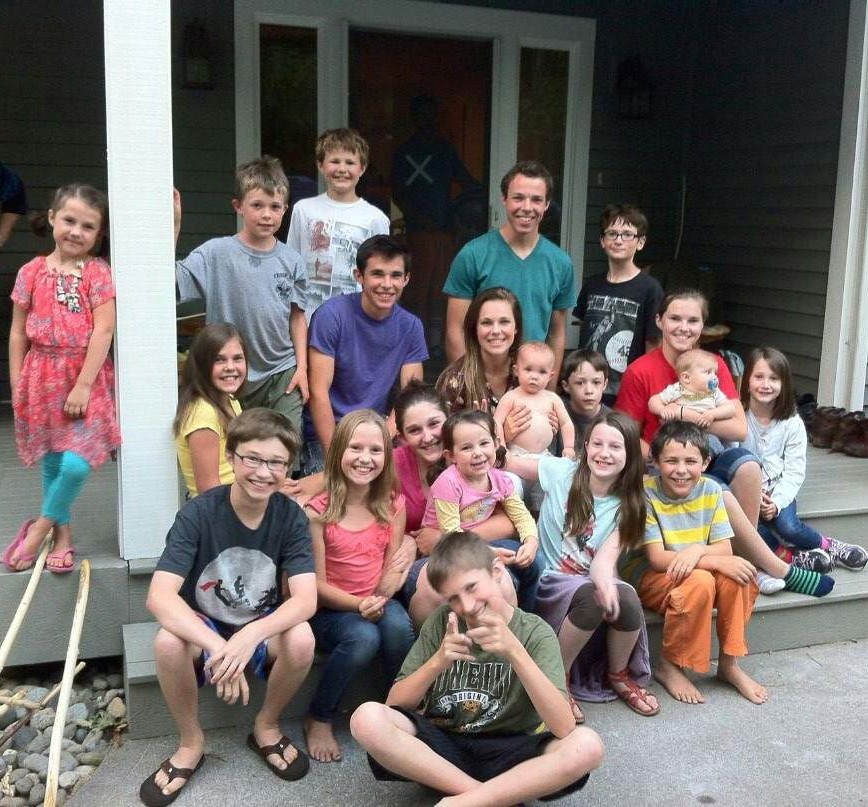
You see, we had this precise time-table for a sequence of events. The planned denouement was the post-retirement move into our new home in Liberty Lake, Washington on April 1. Understanding the importance of managing all the moving parts with a focus on the final objective, we put our home on the market in February. It sold in six days. What followed is not particularly interesting. But the upshot was that our new home would not be ready until late July, and we needed to vacate our Kingston home by May 31. So we are now living in a multi-generational home with one of our sons, his wife and their 2 week old baby boy, another of our daughters and her three children. Count us! Where there were two, there are now nine!

Jimmy is the fifth of our six children. He came along four years after his next oldest sibling Katie and 8 years before his youngest sister Molly. Jimmy never really approved of our parenting. I know that doesn’t sound too unusual. Most kids think their parents are uncool.

But with Jimmy, it was something different. He behaved as though we had failed the test—or worse, that we hadn’t even shown up for the classes. We were simply inadequate to the task at hand. He wanted structure in his life. So when he was eight, and his little sister came along, he had zero confidence in our ability to care for her. As the only competent member of the family, he was reluctant to go to school (as a second-grader) and leave his little sister in the sole care of his marginally competent parents. It was only much later we learned that this behavior was clinical.

Long since, our son has become a man grown. He is married to a beautiful young woman, and they love each other. They also love order. Their counters are always polished. Their floors are always vacuumed. Their laundry is always folded. It’s unnatural. And this is where fate has flung us.

When our children left home, Becky and I were reminded that we are, in fact, tidy people. We were surprised by the ambient neatness that settled on our home when we were alone. But apparently we make allowances for grandchildren and crowds generally. Furthermore, living out of a suitcase does not promote order. The whole air of impermanence discourages the kind of thoughtful arranging that makes possible the everything-in-its-place kind of life style.

When we arrived on the scene, Jim and Carli were expecting their first baby. They had purchased every baby contraption available from Amazon and Craig’s list—most of which vibrate and chirp. Our first child (Jim’s older sister) slept in a drawer. But not our grandson Emmett.

So, where Jim and Carli had been living as a hip, twenty-first century couple, now they have a new baby, a set of grandparents and assorted aunts, uncles and cousins coming and going and beaucoup paraphernalia under foot. Their lives will never be the same. And that makes me smile.

When I look back on these weeks through the gauzy, golden haze of memory, I will be grateful to have enjoyed such a great vantage point for this wondrous time in the lives of our son and daughter-in-law. Even now, and even though not very much about it feels “normal” (whatever that means), it is all pretty marvelous.

“Good night, Grampa.”

“Good night, dear Emmett.”

Weighing Anchor

Standard


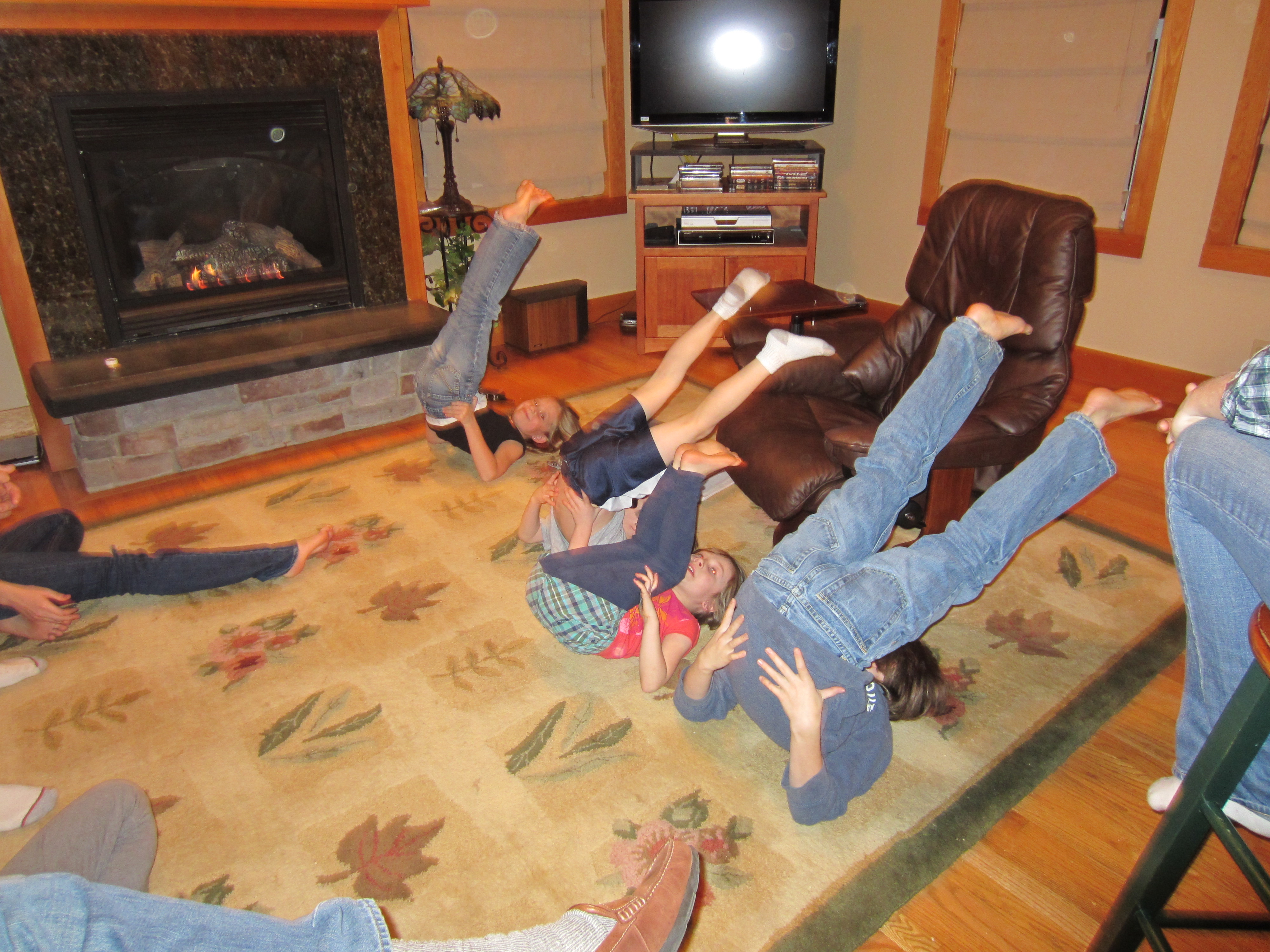
Grandkids always fill the space.

Grandkids always fill the space.

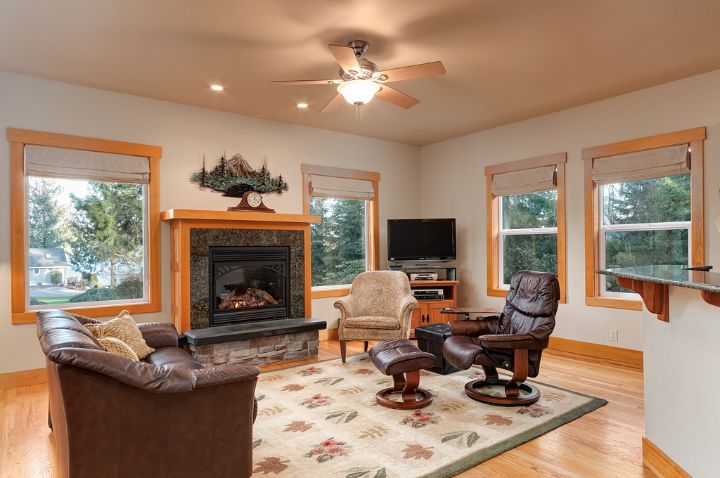
Family Room

When is a house not a home

When is a house not a home


Although I have read the entire Horatio Hornblower series by C. S. Forester and most of Patrick O’Brian’s wonderful stories of Captain Jack Aubrey and Stephen Maturin, I am no sailor.  

The closest I have come to the bounding main is a 22 foot ski boat that we owned some years ago.  We did alright when we were “out to sea”—that is, on the local lake.  Some of our kids were quite good wake boarders and slalom skiers.  Even I could cross a wake with some aplomb.  But when we headed for shore, people on the dock would flee for their lives.  Having watched us through these maneuvers before, they knew that some principle of hydrology or of physics or of seamanship would elude us, and we would careen into the dock.  I suppose we were much like seals:  sleek and skillful in the water (perhaps that is slightly over stated), painfully awkward as we moved onto land.  

For the last 13 years we have been anchored in beautiful Kingston, Washington.  In just two days, we will be moving to Spokane—“east of the mountains,” as we say here.  The last several weeks have felt as though we are weighing anchor.  

This place has been in so many ways more than we ever expected we would experience in life.  We can look out our windows and observe the moods of Puget Sound and gaze at the eroding cliffs of Whidbey Island across Admiralty Inlet.  We can stroll to the beach.  We watch eagles soar overhead or fish in the cove near our home.  We observe the seasonal rhythms of the Alaskan cruise traffic—these silent, alluring vessels glittering with festive lights as they glide past our home in the early morning hours on their return to their Seattle berths.  

This is a green place.  Not “green” in the politically correct sense, although that may also apply, but emerald green.  This past week, on a gloriously sunny, warm day, I was in the car.  Cedar and fir trees line the narrow, winding roads.  Impenetrable forests on either side limit the view of the blue sky to directly overhead.  There are, however, occasional stretches where the maple and alder trees assert a hard-won dominance, arching over the road, creating a tunnel for short distances.  With the bright sunlight filtering through the canopy, it is like diving into an emerald pool.  

I’m trying to catalogue these sights that have exceeded my expectations in so many ways, in the hope that I include them with our hearts’ baggage as we move to another place that is also beautiful, but in different ways.

For now, I have a sense of being rudderless.  We are weighing the anchor of our lives.  For days, few things were in their accustomed place.  Boxes lay about—some taped up and ready, others half-filled, their open flaps askew in anticipation of the last few relevant objects.  We tried doggedly to maintain a semblance of order. The refrigerator was nearly empty—nothing inviting, just scant supplies.  Slowly, our home reverted to just being a house.

Then the movers descended.  They swept everything before them and stowed the accumulation of our lives in the maw of a semi-trailer that was too big to back into our lane.  Consequently, they were forced to park the semi about a mile from our home.  They brought a smaller truck and backed it up to our front porch.  Then they stoically and systematically loaded everything from the house into the “staging truck”, drove it to the waiting semi, then off-loaded everything from the smaller to the larger truck.  They repeated this process over three days.  Because of the added step and time, the process required 3 days instead of the planned two.  They remained cordial throughout.  But I was glad not to be them.

Other things are gone—given away or sold. 

People depend on us less and are making accommodations for our absence.  Our gaze and our thoughts increasingly drift to our new life—the one just over the horizon.  Some friends invited us over for dinner earlier this week.  After a very pleasant evening with people that we admire and enjoy, we drove home.  I noticed that Becky was crying silently in the seat beside me.  We are not second guessing our decision to move.  It’s the right thing for us and for our family.  But it is hard to leave people who have become such a cherished part of the fabric of our lives.

The house is empty now.  The floors have been swept; counters and cupboards, dusted and cleaned; base boards and window sills vacuumed.  It echoes like an empty warehouse.  We walked out the front door and locked it behind us one last time together this evening.

Day after tomorrow we drive away and move on.


Snake Poop

Standard


If you’re a boomer—particularly part of the cutting edge of this demographic—you have become accustomed to the hackneyed reference to the huge mass moving through the body of the snake.  It has never been particularly inspiring to think of yourself as a consequence of unchecked post-war euphoria.  But now, as we have completed the majority of our destined journey through the snake and find ourselves moving inescapably closer to becoming snake poop, the allusion and the reality are even less inspiring.  

We have been repeatedly reminded that we are choking the snake with our sheer numbers.  And, in fact, it seems that now more and more of us are trying to contact the social security administration—which should come as a surprise to no one.  After all, our progress through the snake has been slow and well documented.  But, as those of you who have attempted a call can confirm, a recording informs you that the social security administration is now serving over 50 million Americans, and as proof of that overwhelming fact, you can have the privilege of waiting 46 minutes before being given the privilege of speaking with a very nice person who can’t help you, thank you very much.  

You see, I’m retired now.  Yep.  Retired.  Sixty-six.  I came along in the third year of the boomer wave.  I’m guessing that I showed up early enough that the demographers hadn’t yet come up with a clever name—much less with an understanding of the magnitude of what was occurring in America.  But here we are.

I recently read that there are currently 76 million of us in the U. S.; that we are turning 65 at a rate of 10,000 per day and further, that we will continue to turn 65 at that rate for the next 18 years.  All of this makes me feel rather lemming-like.  

I’m sitting on the porch of our home, looking out over Puget Sound.  It is a spectacularly beautiful spring day, complete with exuberant rhododendrons and azaleas.  I just finished mowing the lawn.  I’m now free to do that simply because it’s a sunny day and the lawn needs it.  I no longer have to wait for the convergence of dry grass and Saturday.  Did I mention that I’m retired?

My goal here is to document life after everything else.  I suppose that there has always been time for reflection.  It’s just that we tend to fill it up with other stuff.  Now, I feel more inclined to consider what has past, and more to the point, what lies ahead.  

You are welcome to join me if you like.  But I feel like I have embarked on something that is important and urgent.  So I’m making the journey whether you come along or not.